
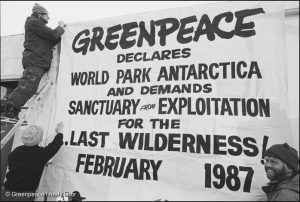
 In 1987 Greenpeace established the ‘World Park Base’ in Antarctica which stayed until 1991
World Park Base was a non-governmental year-round Antarctic Base located at Cape Evans on Ross Island Antarctica.
Greenpeace established that small base at Cape Evans on Ross Island (77° 38’ South, 166° 24’East) in the southern (austral) summer of 1986/87. Named World Park Base, it was to be the focal point of future campaigning activities, providing a “watchdog” presence in the Antarctic. During its existence, it enabled Greenpeace to gain first hand experience of operating a base on the Continent and to monitor and publicise the activities of other nearby stations.
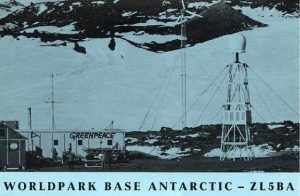 The main Bbase building was constructed in 1987 from prefabricated units, which were designed and manufactured by a German polar construction and engineering company. Between 1988 and 1990 several structures were added. Eventually, basebuildings consisted of an L-shaped main building and a small food storage and emergency building. The main building comprised an accommodation unit housing a common living area, four separate bedrooms, a bathroom, radio room, medical and science room, coat room and a room containing snow melting equipment. A cold porch was also attached. The engine room was housed in the same building, separated from theother facilities by a walkway. A lean-to was used for storage. The short side of the L-shaped building was formed by another unit joined to the main building by a walkway which housed a workshop, science lab, dark room and field equipment store. The latter unit, called the FOS hut, had been acquired from the Footsteps of Scott Expedition which had previously had a base at the site.
  The original base was designed to accommodate four persons. In later years, a workshop and laboratory building and two more bedrooms were prefabricated and added to the original structure as it became apparent that extra space was needed for the wintering teams. These additions were simple to construct andinstall, with minimum excavation necessary. Also installed on the base was amateur radio equipment for contact with Ham radio enthusiasts worldwide, and a Uosat satellite link that was part of a scientific project run in conjunction with the University of Sussex in the United Kingdom.
.
Two Ham Stations did operate from there: ZL5BA (1988) and ZLØAIC (1990)
Source: Wayback Machine (archive.org)
 Thanks to our friend Volker DL8JDX, for this rare and old picture. A personal gift from Leonid Labutin UA3CR (SK 1998).
 1982-1983. Expedition to Antarctica with Malakhov, Shishkarev, Redkin and Leonid Labutin. Active work on board ships. Visiting radio amateurs in the Canary Islands, Brazil, Uruguay. Work with Druzhnaya Base (
 New research on Antarctica, including the first map of iceberg calving, doubles the previous estimates of loss from ice shelves and details how the continent is changing.
 DPØPOL/mm is also on the air irregularly from I/B Polarstern. Operators are Andy DL3LRM and Jörg DJ0HO. There is regular activity from DPØGVN and DP0POL/mm on QO-100 satellite, see
  VU2CUW , Sarabjeet S. “Sunny” Chhabra , 25 years old electronics and communications engineer currently working as a design engineer for a CNC Machinist is joining the Indian Antarctic campaign 2022-2023.
 Polar Ship RRS Sir David Attenborough
 Arctic and Antarctica are brother Poles , and its a great pleasure for
  Today, the foundations for two more masts were frozen in ice. Tomorrow we will raise the main mast for KV – 15 meters, after that the laying of cable routes and the installation of antennas.
 Wolf Fang Runway (
 The Polar Salon is an international “worldwide” polar philatelic exhibition that takes place in various parts of the world every three years, mostly as part of national or international exhibitions. Organizing Committee of European Stamp Exhibition LIBEREC 2022, together with the clubs of polar collectors decided to organize the 5th International Polar Salon in Liberec, Czec Republic in 2022.
 WAP
WAP Maiviken Hut located at 54°14’52” South, 34°30’23” West , next to Maivatn lake, in the Bore Valley. Next to the lake lays this cozy little hut built in 1974 and kept in good conditions, being normally used by King Edward Point scientists. It was a quite precarious shelter in the past but is getting recently renovated.. At the present times Maiviken is often visited by scientist from King Edward Point for research purposes, mostly surveying Fur seal population and Gentoo penguins nesting at Tortula Cove.
 On October 7, 1985, at the XIII Consultative Meeting held in Belgium, the Eastern Republic of Uruguay was accepted as a Consultative Member of the Antarctic Treaty, thus becoming part of the group of Nations that have a voice and a vote in the decisions of the international community of Antarctica. In recognition of this fact of enormous importance, every year Uruguay celebrates October 7 as
  Commenting on the verses of Delia M. Musso about Antarctica, Prof. Ricardo Pallares says:
 I recall when on 14th may 2014 I did receive a great gift from Dr. Lyubo.
 What is the Antarctic? Some extraordinary nature on the border between the earthly and the cosmic? A treasure trove of natural resources of global importance? A land with a no longer small history of heroic efforts on the limit of human abilities? Or the future home of numerous settlers? Whose is the Antarctic? Is it a common heritage that will continue to be managed jointly by a group of countries under the provisions of the Antarctic Treaty? Or is it, on the contrary, yet to be partitioned into separate possessions? Many questions, with still more answers.
 Dr Ivanov has taken part in several Antarctic expeditions. In 2004, Ivanov went with Doychin Vasiley on the Tangra 2004 topographic expedition, noted by Discovery Channel, the Natural Historic Museum, the Royal Collection and the British Antarctic Survey as a timeline event in Antarctic exploration. Awarded the jubilee medal 30th Bulgarian Antarctic Expedition by the Bulgarian Antarctic Institute for his active participation in the expeditions and in the building of St. Kliment Ohridski Base (
 Thanks to Olivier F6EPN (aka Spratley Woody at his Facebook page), another old and rare QSL card, KC4USA dated 1949 proves that Ham Radio was performed at this Base, which was not present on WAP-WADA Directory.
 After the war, Little America IV consisting of an airstrip and 60 tents, was set up nearby as a headquarters for Operation High Jump (1946–47), an expedition designed to explore and document Antarctica’s coastline as well as to extend U.S. sovereignty to the continent. When an expedition next returned (1956) in preparation for the International Geophysical Year (1957–58), parts of the earlier Little America camps were found to have vanished because of calving of the ice shelf.
 Little America IV camp was thug established as US Navy’s Operation Highjump, of 1946–1947.