
In a meeting between Enacom (Ente Nacional de Comunicaciones ) and the Antarctic Department, an interestring decision has been made: -Personnel who does not have an Amateur radio license, joining the 2023 Argentine Antarctic campaign, will be trained in intensive course Hamradio technics. Th training will start in october 2022-.
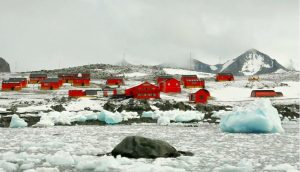 The meeting took place last week between ENACOM, represented by Professor Marcos Lafón Fariña from the Stations and Services Registration Area (Amateur Radio), and authorities from the Joint Antarctic Command. They have made analisys about the situation of the Antarctic operators which, in some cases, show up on Hamradio bands, from the different Argentinean bases, without the enabling license.
 It was decided to give an intensive course next October 2022, to obtain the amateur radio license for all the operators that will integrate the different crews in the 2023 campaign to the white continent.
The purpose is that they can go on the air with the callsigns of each base and communicate with Hamradio colleagues from all over the world. In the case of the Bases that already have operators with a radio amateur license, the activity in the different enabled bands will continue normally.
WAP congratulate both ENACOM and Comando Antartico Argentino for such a great decision. Many thanks for your sensitivity and attention to the HF Radio activity and Radio amateurs.
TNX to Carlos Almirón LU7DSY for sharing this information
 Activity of Argentine amateur radio stations in Antarctica, in addition to maintaining a reliable communications service, useful and important in regions like these, contribute to the diffusion of HF activities and promotion of Argentine sovereignty in the region. These activations have several purposes and objectives beside the usual DX activations.
 The Maudheim Research Station (Maudheim , which Norwegian translates as house Maud) was the Base camp of the Swedish-British-Norwegian Antarctic Expedition including members of Australia and Canada between 1949 and 1952 .
 QSL below, dated November 7th 1950
 Logging a station operating from/in Antarctica has always been one of the best DX even wished. Several Hams, particularly the Old Timers are far above but just few of them can have over 200 Antarctic Bases on their logs! Years of years of continuous monitoring, setting skeds, follow Antarctic expeditions and scientific seasons, with the only goal to work a new one.
 Bob has also achieved the TOP of the Antarctic Challenge 2020 Award with 203 Antarctic/Sub Antarctic Bases and Refuges.
 The Henryk Arctowski Polish Antarctic Station was established in 1977 and is now in need of serious improvement works. The Ministry of Science and Higher Education (MNiSW) is to grant new funds to the Henryk Arctowski Polish Antarctic Station to rebuild its infrastructure. “It can be stated firmly that the Polish Antarctic Station is our unofficial embassy in Antarctica. Every year it is visited by official international delegations, representatives of Antarctic programs of other states, as well as tourists from all around the world”, Minister for Science and Higher Education Jarosław Gowin announced on Wednesday, “However, this is not the most important for us”, he added. “The most important are the broad research capabilities which the station provides to Polish scientists.”
 The reconstructed Henryk Arctowski Polish Antarctic Station is expected to start operation in 2023, Agnieszka Kruszewska from the Institute of Biophysics and Biochemistry at the Polish Academy of Sciences (IBB PAN), the station’s managing institution, has told. The rebuilding of the infrastructure and a new main hall of the Polar Research Station in the Antarctic will cost PLN 88 million (EUR 20.4 million) and will be financed with Poland’s science ministry’s grant, she added.
 Now, for the first time, a research team has been able to show systematically that the fin whale population is recovering. The findings were published in the journal Scientific Reports.
 Scientists have identified the bacterium that produces palmerolide, a compound discovered in sea squirts living in Antarctic coastal waters that could potentially treat human melanoma, the most dangerous form of skin cancer.

 2022 is the 65th anniversary of the International Geophysical Year, or IGY, a collaborative, worldwide effort among 60 countries, 10,000 scientists and multiple scientific fields to study the Earth and sun. Today we celebrate the amazing contributions made possible by one of the most successful international scientific efforts in history.
 so scientists could study sunspots and observe the sun’s corona during a solar eclipse. Scientists designed and built instruments to study the atmosphere and near space environment, deployed seismic equipment to study earthquakes and ice sheets and used newly constructed radio and astronomical observatories to observe the sun and stars. For their research, scientists adapted many technologies first developed during World War II.
 The U.S. National Science Foundation, which had been established just seven years earlier, was instrumental in supportingand coordinating IGY research by U.S. Scientists. NSF began planning for the IGY and issuing grants to researchers in 1955, a massive undertaking that required building infrastructure to house and support scientists in some the most remote and harsh environments on the planet.
 Founded by Belgian polar explorer Alain Hubert, Prof. Hugo Decleir and Prof. André Berger in 2002, the Brussels-based International Polar Foundation provides a novel interface between science and society, and was recognised by Belgian Royal Statute as a foundation for the public good in 2002. HM King Philippe is the International Polar Foundation’s honorary President.