 The sun, won’t rise again until September.
Six months of darkness are one of the reasons powerful telescopes are located at the South Pole. (Amindsen-Scott US South Pole Station, WAP USA-21 & WAP USA-36).
The photo by Danny Hampton (here aside), shows the South Pole Telescope, operated by the University of Chicago, as they study the origins of the universe.
Thanks and credit to: The Antarctic Support Contract
The Antarctic Support Contract team provides station operations, logistics, information technology, construction, maintenance and more on Antarctica and at support facilities worldwide.
Supporting scientific research on the highest, driest, coldest, windiest and emptiest place on Earth requires exceptional logistics and planning expertise. Leidos is the prime contractor for the National Science Foundation’s United States Antarctic Program (USAP).
See more at: https://www.leidos.com/competencies/operations-and-logistics/antarctic-support-contract

 Beyond all names that are attributed to it, Point Wild on Elephant Island, hosts the bust of Luis Antonio Pardo Villalòn, the Chilean Navy Officer who, in August 30th 1916, commanded the steam Tug Yelcho to rescue the 22 stranded crewmen of Sir Ernast Shackleton’s expedition who survived the wreck of the ship Endurance living for four and one half months in this island.
 seaweed untill they were finally rescued by Shackleton aboard the Chilean ship Yelcho.
 On the April 2020 issue, the German CQ-DL Magazine dedicates several pages to report the QO-100 activity with particular regards to the contact made from Neumayer III Station (WAP DEU-Ø8) and the students at school.
 save Sir Ed’s hut in Antarctica is now largely complete
 The “A” Hut has been designated a Historic Site or Monument (HSM 75), following a proposal by New Zealand to the Antarctic Treaty Consultative Meeting.
 For several weeks, scientists working at Vernadsky in Antarctica have been surrounded by what they call “raspberry snow”. Images released by Ukraine’s Ministry of Education and Science on Monday showed the phenomenon, which is caused by microscope snow algae when weather conditions are favorable during Antarctica’s summer months.

 XR8RRC/p – WAP CHL-13
 Antarctica’s bicentenary year, a right time to join UKAHT, a site that keeps the Antarctic enthusiast up to date with lots of exciting work in Antarctica and beyond.

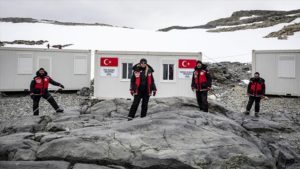 Turkish scientists continue their scientific research on Horseshoe Island in Antarctica. After the construction of Turkey’s first temporary science Base on the island (67°49’40” South, 67°12’08” West), the Team welcomed a group of guests from Chile, Bulgaria, the Czech Republic and Ukraine for the first time. The six guest scientists did work together with the 24-member of the Turkish research Team joins 15 scientific projects in the Earth, life, and marine sciences.
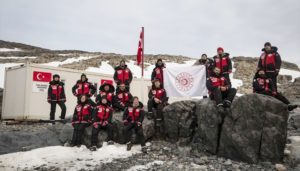 “The GNSS satellite navigation base station was set up within the framework of the fourth Turkish scientific expedition to Antarctica” said Turkish Industry and Technology Minister Mustafa Varank, as quoted by the national Anadolu news agency. “A group of specialists from the Turkish General Directorate of Mapping has built Turkey’s first GNSS base station abroad.”
 (1 nmi) long and 60 metres (200 ft) high, which is mainly ice covered and is the largest of the Faure Islands, an archipelago lying in Marguerite Bay off the west coast of Graham Land.
 Prof. Carla Caruso and Dr. Laura Bertini (pic aside) of the Department of Ecological and Biological Sciences of the University of Tuscia in Viterbo (Italy) will be back home next march 15th after a month-long mission in Antarctica.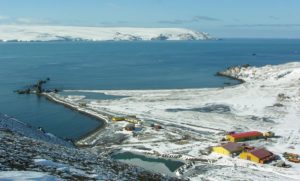

 «Antarctica can serve as a model for all humanity today. It’s a Continent without national borders. It is governed by the Antarctic Treaty, which has been in existence for 60 years. This is a superb document, which gives Antarctica to the scientists, not to the military»