
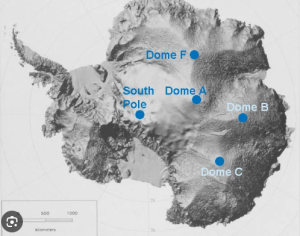
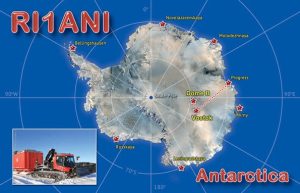
 The region of Dome B (or Ridge B) in central East Antarctica is one of the last unexplored parts of the continent and, at the same time, ranks among the most promising places to search for Earth’s oldest ice. In January 2020, a first scientific traverse from Russia’s Vostok Station to the topographical Dome B (or Ridge B) at 71° 07′ 04,80″ South, 84° 19′ 15,6″ East.
The glaciological program included continuous snow-radar profiling and geodetic positioning along the traverse’s route, installation of snow stakes, measurements of snow density, collection of samples for stable water isotope and chemical analyses. A 20.5 meters deep borehole was drilled on the Dome itself, followed by a study of the raised firn core. As a result, it was possible to obtain the first field glacio-climatic data on Dome B.
The first results of the traverse show that the surface mass balance at Dome B (2.28 g cm−2 year−1) is among the lowest in Antarctica. The firn temperature below the layer of annual variations is −58.1 ± 0.2°C. A very low value of heavy water stable isotope content (-58.2‰ for oxygen-18) was discovered at a distance of 170 km from Vostok Station (WAP RUS-13). This work is the first step towards a comprehensive reconnaissance study of the Ridge B area aimed at locating the best site for future deep drilling for the oldest Antarctic ice.
First traverse and Temporary Dome B Camp
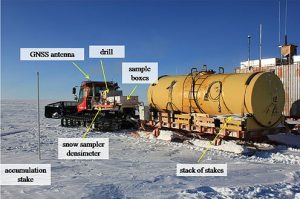 To reach Dome B, the first traverse started from Vostok at 2 p.m. local time on 24 January 2020. The caravan consisted of two PistenBully 300 Polar tractors, one balok (a crew box mounted on a sledge) and one fuel tank. Throughout the entire journey the Team performed kinematic Global Navigation Satellite System (GNSS) measurements as well as GPR profiling. Every 5km the traverse made a short stop for glaciological observations, (installation of a snow stake, measurements of upper snow density and collecting snow samples for water stable isotope and chemical analyses.
The scientific traverse to Dome B, was equipped with scientific equipment including a sledge with the snow radar towed behind the traverse, GNSS (Global Navigation Satellite System). The average speed of the traverse on the move was 9.7 km h-1, meaning that 5km intervals were passed approximately every 31 minutes. Aside from the short stops, the Team also made four longer stops a day for refueling, meals and rest. At such a speed, the traverse arrived at Dome B at 6 p.m. on 26 January.
 On arrival at Dome B, firstly the Team set the camp and installed the drilling equipment and organize static GNSS measurements. The next day they completed the drilling of a 20.5m firn core and installed geodetic markers for the precise determination of local flow directions and velocities. The firn temperature was measured after 12h equilibration of the platinum thermometer at the hole’s bottom at 20.5m depth. A snow stratigraphy investigation and snow sampling were carried out in a 2m pit. Finally, a seven-snow-stake farm was set up in the vicinity of the camp. The traverse left Dome B at ∼5 p.m. on 28 January 2020 and arrived back at Vostok Station in the early morning of 30 January 2020.
Thanks to Oleg UA6GG @ DX Trophy, WAP did received the following information about next RI1ANI activity by Alexey RN1ON
In the 2025-26 season, Alexey Turkeev, UG1A-RI1ANI, was not at Dome B. They had planned it, but they didn’t meet the deadlines. RI1ANI worked instead from Novolazarevskaya (WAP RUS-Ø9) and from the Progress–Vostok expedition. This season, they are planning another expedition to Dome B.
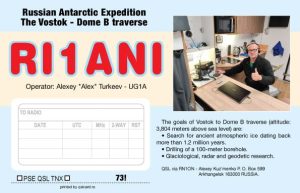 On October 21, Alexey Turkeev RN1ON will fly from St. Petersburg to Cape Town. Then a flight to Novolazarevskaya (WAP RUS-Ø9) and Progress (WAP RUS-11). The campaign to the East and then to Dome B will then start.. RI1ANI will work the beam trailer vehicle. There are no exact deadlines yet, but Oleg and Alexey will keep us informed. RI1ANI license will be active again from November 21 of this year.
At he light of the information collected about the “Overland Glaciological Temporary Camp Dome B” which identify the site, the news recently received of a planned activity, the QSL already prepared, WAP is going to add “Overland Glaciological Temporary Camp Dome B” on WAP WADA Directory as WAP RUS-NEW.
.
As soon as RI1ANI operation will take place a new WAP number will be issued.
TNX Oleg UA6GG and Alexey RN1ON/RI1ANI
 New Zealand’s Scott Base


 The U.S. National Science Foundation congratulates Prof. Francis Halzen on winning the 2026 Nobel Prize in physics for his major contributions to the
 Recently in a post, we have been pleased to observe the consistently high level of attention within the Antarctic and sub-Antarctic regions ,regarding Christianity and the sentiments that have driven various nations to strongly desire a place of worship in their respective territories.
 The Norwegian Anglican Church in Grytviken, South Georgia, is a historic wooden building consecrated on Christmas Day in 1913. The founder of Grytviken Whaling Station (

 Polar Philately is the specialized collecting and study of postage stamps, postmarks, covers, and mail tied to the Arctic and

 Many Countries tell their polar story through philately. Norway honored Roald Amundsen’s 1911 South Pole feat in 2011. The British Antarctic Territory issues wildlife definitives, including the 2023 £2 Penguin. Australia’s AAT series features the icebreaker “Aurora Australis”. The USA commemorated Byrd’s 1933 Antarctic Expedition II flights with a 3¢ stamp. Russia marked Mirny Station’s 50th anniversary in 2006. Argentina issues “Día de la Antártida Argentina” stamps annually, while New Zealand’s Ross Dependency celebrated Scott Base’s 60 years in 2017. France’s TAAF continues its long-running Emperor Penguins and Kerguelen issues.
 On May 23-30, 2026,

 Lot of work in QSLing is occupying Denney George, VU2DGR/AT44I after the return to his homeland after a long stay in
  After the incredible performance of Bhagwati VU3BPZ; the
 The Mawson’s Huts Foundation is excited to announce that the full festival program is now live!
 The Scott Base redevelopment, with the signing of the main construction contract with LT McGuinness Ltd is an exciting step towards creating a modern, resilient Antarctic research station that will support science, operations and New Zealand’s presence in Antarctica for decades to come.

 Heard Island (53°06’ South, 73°31’ East) and McDonald Islands (53°02’ South, 72°36’ East) , mostly shown together, are a
 Midwinter Day, the most prominent cultural holiday in


 3G9S
3G9S  The primary, physical scientific building on Navarino Island is the Cape Horn Sub-Antarctic Center (known locally as the Centro Subantártico Cabo de Hornos). Located in Puerto Williams, this iconic facility serves as the headquarters for the Cape Horn International Center (CHIC). It is the world’s southernmost climate change research station. Designed by the international firm Ennead Architects, the building’s architecture mimics a “three-canoe” form. This design provides shelter from harsh Sub-Antarctic winds and maximizes solar exposure. The building is split into three integrated pavilions:
 Alfred-Faure or Port Alfred is a permanent French Scientific Station on Possession Island of the subantarctic Crozet Archipelago in the South Indian Ocean.
 Permanent occupation with a Scientific Station, is dated from 1963. The 20 small mountainous islands of Crozet are a French territory and are uninhabited except for scientific personnel and penguins. Home to seals, King Penguins and other birds, Crozet is designated a “National conservation area” by France.
 Overfishing in recent years led the French to declare an exclusive economic zone around their islands in this part of the world in 1978. Today, the French Navy patrols the zone.
 The Southern Aurora Donga (or
 In 2026, hard work has been done in upgrading expeditioner accommodation at Macquarie Island Research Station as part of the Macquarie Island Station Project, including upgrading bedrooms, re-cladding, and improving amenities at its structure.
 The Ross Island Earth Station (
 Situated on the Hut Point Peninsula of Ross Island, it offers a direct line of sight to satellites that were previously more difficult to access from other locations on the continent.


 We are happy to congratulate Augustyn SP6BOW for achieving his goal and thanks to the editorial staff of the
  The project, utilizing the icebreaker RSV Nuyina, focused on critical climate research, wildlife monitoring, including checks for H5 bird flu, and environmental cleanup.
 China operates five research stations in Antarctica:
 Three of these stations: Great Wall (WAP CHN-Ø1, Zhongshan (WAP CHN-Ø2), and Qinling (WAP CHN-NEW) are equipped for year-round operations, while Kunlun and Taishan are seasonal Summer Stations.
 South Georgia big efforts are going on for the announced VPØSG South Georgia 2027 DXpedition.
 On May 2026’s issue, German Ham Radio magazine CQ-DL 5-2026 show two pages written by Reiner Schloßer, DL7KL; a new article, tracking a portrait of one of our best Ham friends: Oleg Sakharov R1ANF-ZS1ANF-ZS7ANF a real Antarctic veteran. Thanks to him a huge number of WW Hams have got a chance to log a bunch of new Bases, remote sites & Refuges in
  On April 15, 1922, the Quest arrived at Leith Harbour (
 In 2014, China established a second inland summer station, Taishan Camp (
 Situated on the inland ice sheet at an altitude of 2,621 meters, it lies about 520 km from Zhongshan Station (
 After 45 days of hard work, Taishan Station looks like a traditional Chinese lantern. Construction of it began in December 2013. The 28 strong-team braved temperatures as low as minus 40 degrees celsius, snowstorms, and high-altitude conditions to build the station.
 Mara Virginia Schmid, a scientist at the Argentine Antarctic Institute and First Sergeant Franco Paolo Ormaechea of the Argentine Army, met in 2014 at Esperanza Base (
 Since 1978, when Civil Registry No. 2,506 was established at Esperanza and the first families began to settle there with the construction of Fort Sargento Cabral, a year-round civilian settlement, the Base has been the setting for celebrations that are part of Argentine Antarctic history.
 Observation Hill is a steep rocky slope (750 ft/230m) intimately connected to both USA and New Zealand research sites in
  A magnitude 6.6 earthquake was recorded Thursday night (Mar. 19th6, 2026) in the Antarctic region, approximately 998 kilometers from Ushuaia and near Base Presidente Eduardo Frei (
 Denney George VU2DGR , signing AT44I has been the Communication Officer at Bharati Station (
 Argus, the icebreaker, is named after the giant in Greek mythology. The ship is maneuverable and a robust and reliable icebreaker.
 DX-pedition of the year in a very rare spot in the Sub Antarctic: Bouvet Island, one of the most wanted DXCC among WW Ham Radio. The big guns have already worked 3YØK on several Bands and Modes and now a question arise: “Where on the island they did set the two camps?”
 Among the information received it seems that one camp is for North America (North America Camp?) and one for the rest of the world. Both camps are safe and secure with 8 tents in total. One camp is located at the NA focus location.
 Another question that arose from the Hams/ Antarctic Chasers: «How can we know which of the two camps we have worked?»
 On February 22, 1968, the year-round Soviet Polar Station Bellingshausen began operating in West Antarctica, 58 years since then!
 The first wooden houses built here were designed for 20 people. And already in the 70s, wooden houses were replaced with more reliable aluminum buildings. During the same period, a powerful radio center appeared at the station, which served not only scientists, but also the fishing fleet in the southern Pacific and Atlantic Oceans.
 It was only in 1997 that the Government again allocated funding for the implementation of the Russian Antarctic Expedition (RAE). Thanks to this, Russia has maintained its geopolitical presence in Antarctica, and its scientific human resources have been saved.

 In the mid 1990s, Patriarch Alexius II of Moscow gave his blessing for this audacious project. The church was constructed in Russia and transported by a supply ship to its present location. One or two monks from Troitse-Sergiyeva Lavra, considered the most important Russian monastery as it is the spiritual center of the Russian Orthodox Church, volunteer to man the church year-round.
 On Saturday, February 21st, starting at 3:00 PM, the city of Imperia did celebrate an Antarctic Day at the Auditorium of Naval Museum , featuring the Cepparo HF expedition radio equipment.
 In addition, Gabriele IK1NEG who did moderate the event, announce that he will be active as II1SR/p (
 Today marks 122 years of uninterrupted Argentinean presence in Antarctica. On February 22, 1904, Argentina began its institutional Antarctic presence by taking charge of the meteorological observatory on Laurie Island, in the South Orkney Islands.
 Black Island, USA Telecommunication Facility is listed on
 February 15, 1953: British forces landed on Deception Island (South Shetland Islands) and destroyed the Argentine Refuge, Lieutenant Lasala (picture attached), as well as a nearby Chilean Refuge. They even demanded passports and visas to remain in what they considered “British Territory.”
 On February 13, 1956, the first Russian Antarctic Research Station was opened on the Davis Sea coast marking the beginning of continuous scientific observations in Antarctica.
 The expedition was led by the famous polar explorer and outstanding polar researcher, the head of the drifting station “North Pole-2”, Hero of the Soviet Union, Mikhail Mikhailovich Somov. (pic aside)
 In addition to the 7Øth Anniversary of Mirny Station, it is also interesting to know that, on Jan 5, 1956, the diesel-electric ship Ob carrying a team of Soviet scientists and polar explorers reached the Antarctic continent. From that day onward, large-scale national research in Antarctica began. The work of these pioneers is still carried forward today by the Russian Antarctic Expedition of the Arctic and Antarctic Research Institute (
 He is on board of the Research Icebreaker since a couple days now and plans to participate in
  In memory of the 1st Italian Base in Antarctica, Saturday, February 7th, 2026, members of the ARI (Italian Amateur Radio Association) of Grado gathered early on Schiusa Island, operating a SES “
 Of Roman origin, Grado (gradus, landing) was founded in the 2nd century AD as fisherman’s village and, later, harbour for ships sailing up the river Natissa towards Aquileia. Grado developed, around the middle of the 5th century AD, when many inhabitants fled to the island to escape the devastating Hun hordes led by Attila which, in 452 AD, destroyed nearby Aquileia. During that eventful period, the Patriarch of Aquileia moved to Grado and proclaimed himself Patriarch of this site. Grado remained an independent Patriarch site until 1451 even if, in the middle of the 12th century, the Patriarch himself moved his residence to Venice.
 DL1RUN Karsten Stephan, is a keen Antarctic hunter and owner of Special Event Stations to celebrate Antarctica: DAØANT (WAP-128), DQ6ØANT (
 While earlier expeditions explored, the GvN in 1981 established consistent year-round research, fulfilling the “5Ø years ago” timeframe and solidifying German scientific commitment.
 The “New Depot Camp” is a seasonal base where fuel and all kinds of cargo are being reloaded. The camp is located at 70°17’57” South, 02°25’17” West, as shown in the attached locator map, practically near the ice covered Blåskimen and Novyy Islands.
 Bull Pass at 77°26’4Ø”South, 161°51’Ø6″East, is a remote site in the Dry Valleys, Southern Victoria Land near McMurdo Station in Antarctica that hosts Huts & Communication Station; a couple of research and refuge structures being recently visited by KL5SE Andrew T Winkelman.
 Exactly 50 years ago, on January 20, 1976, with the raising flag ceremony Renato Cèpparo, I2VZP, did inaugurate the first Italian Base on the Antarctic Peninsula. Interestingly, the motor vessel Cristoforo Colombo set sail from the port of Tieste with 22 tons of prefabricated material to build the base.
 Tuesday, January 20, 2026, a ceremony marking the 5Øth Anniversary of the inauguration of the Base named after the 19th-century hydrographer, sailor Giacomo Bove, was held in Triste (Italy).
 Despite the freezing wind and poor propagation, a group of students of the Carducci-Dante High School, led by Prof. PhD Julius Fabbri (IV3CCT) did operate


 EM3ØVER (

 The following is the presentation of an idea we’ve been struggling to bring forward for more than 20 years. We’ve tried to involve politicians and civil, military, and religious authorities, but believe me, the bureaucracy is a major obstacle!
 Bull Pass Huts & Communication Station at Bull Pass Dry Valley, Southern Victoria Land at 77°26’4Ø”South, 161°51’Ø6″East, are a couple of research and refuge structures located in the Dry Valleys, near McMurdo Station in Antarctica.
 Bull Pass Huts & Communication Station are still used by scientific expeditions for study, especially in geology and biology, with older US structures remaining but designated as a decommissioned site within an Antarctic Specially Managed Area, this site offers a glimpse into the fragile, ancient ecosystems studied there.
 In essence, Bull Pass Huts are though scientific outposts known more for its unique ice-free landscape and its extreme environment, with temporary field shelters used by researchers rather than permanent historical dwellings. The Dry Valleys are famous for being ice-free, making them crucial for scientific study.
 Born (June 13, 1928) in Birmingham, England, Dr. Bull first ventured into the Arctic as part of a 1951 university expedition to the island of Spitsbergen. After taking a university job in New Zealand, Dr. Bull launched one of the first expeditions to the dry valleys of Antarctica, eerie ice-free basins where temperatures in the spring and summer, range between subzero and shirt sleeves.