
 The Maitri II project is India’s initiative to build a next-generation, permanent research station in East Antarctica to replace the aging Maitri research station. Led by the Ministry of Earth Sciences and the National Centre for Polar and Ocean Research (NCPOR), the facility is planned to become fully operational by 2032.
Project Maitri-II: Advancing India’s Antarctic Vision
Dr Srinivasa Kumar Tummala, Secretary, MoES, accompanied by Shri S. Gopal Krishna, Joint Secretary (IFD), discussed preparations for Project Maitri-II. Dr Shailendra Saini, Group Director (Antarctic Operations), briefed the delegation on the Global Design Competition and the roadmap ahead. The delegation also visited the proposed site to assess the location and review the progress and preparedness for this ambitious initiative.
Thanks and Credit: NCPOR Goa, Press Information Bureau – PIB, Government of India
Key Project Overview
Purpose. It will replace the original Maitri base—operational since 1989—which is nearing the end of its structural lifespan.
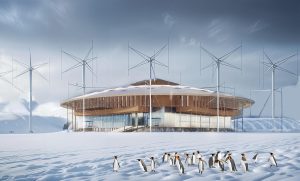 Situated in the Schirmacher Oasis in Queen Maud Land, East Antarctica, near the current Maitri station.Designed to house around 140 personnel in summer and 40 in winter, with an overall estimated project cost of roughly ₹2,000 crore (following an initial ₹29.2 crore approval for architectural design and the Detailed Project Report).
Pre-investment, design, and planning phases began in late 2025, targeting operational completion by January 2032 (following earlier preliminary targets of 2029).
Designed by Samyn and Partners alongside R.dx Architects and Extreme Planet RXD, the station is built for extreme sub-zero conditions and strict environmental compliance under the Indian Antarctic Act, 2022. Aerodynamic structure, spans roughly 14,436 square meters under a 105-meter spherical cap elevated 1 to 2 meters above the ground to prevent snowdrift accumulation.
Prefabricated wood panels and steel components will be shipped via Cape Town for rapid assembly during brief Antarctic summers. Powered by a 170-meter circular energy ring featuring 1,800 square meters of solar photovoltaic panels and 8 to 10 vertical-axis wind turbines.
India’s Antarctic Stations Footprint
 Dakshin Gangotri (WAP IND-Ø1), India’s first base, established in 1983.
Dakshin Gangotri base was officially decommissioned on February 25, 1990, after being abandoned around 1988–1989 due to becoming submerged and buried under ice. After decommissioning, the site was converted into a supply base and transit camp.
Indian Bay Camp (WAP IND-Ø2)) is a coastal inlet along the Princess Astrid Coast in Queen Maud Land, East Antarctica. Located near 69°59′South, 11°57′East along the Lazarev Sea (part of the King Haakon VII Sea) and bordering the Fimbul Ice Shelf, it is best known as the historic landing site of India’s first Antarctic expeditions.
Maitri (WAP IND-Ø3) Currently active (to be replaced) in operation since 1989; India’s second permanent station located near Lake Priyadarshini.
Bharati (WAP IND-Ø4) Built in 2012. Currently active, Located ~3,000 km east of Maitri in the Larsemann Hills.
Maitri II (WAP-IND-NEW) at 70°46’02.3” South, 11°43’24.5”East–
In Development ~2032 (Target); Next-generation green facility will replace Maitri.