 The Italians did participate in the first Antarctic missions mostly as members of expeditions and/or with the support of other Countries.
Giacomo Bove, at the end of 1800, unsuccessfully sought funding for an Italian Antarctic Expedition and then carried out one in the sub-antarctic islands on behalf of Argentina.
Pierre Dayné, an Alpine scout from the Aosta Valley, was the first Italian to spend the winter in Antarctica. It was the 1903-05 expedition of Jean Baptiste Charcot.
Luigi Bernacchi, was a doctor on the Borchgrevinck expedition. He spent the polar night of the year 1900. Bernacchi was not exactly an Italian but a Tasmanian of Italian origins.
Around the 1950s an Italian film expedition, under the direction of Arturo Gemmiti did work for a while at the Chilean bases.
 Lieutenant Franco Faggioni carried out seismic measurements at Scott Base during the International Geophysical Year of 1957. (See pic aside)
In the same years, a passionate scholar of the Arctic and Antarctic, Silvio Zavatti, tried to organize a national expedition but the time was not ripe; he managed to visit Bouvet Island anyway. As a scholar and explorer he promoted expeditions to Greenland and Antarctica and in 1958 he developed a program for the construction of a permanent Italian scientific base in the Norwegian Antarctic sector.
We were already in the early 60s when an Italian group of researchers joining the Belgian expedition, performed an ice core drilling in Queen Maud Land.
In 1962, geologist Ardito Desio was able to visit the Dry Valley, near the American McMurdo Base, and also the South Pole Station.
The mountaineer Carlo Mauri also visited Dry Valley a few years later (1967) as a guest of the New Zealand mission.
Between the late 1960s and early 1970s, an enterprising merchant navy officer, Giovanni Ajmone Cat, made two trips from Italy to the Antarctic Peninsula aboard a felucca of which he was the designer and captain, as well as the owner. It was the first time that a vessel flying the Italian flag sailed in Antarctic waters.
Italian sensitivity towards the Antarctic, was therefore maturing in those years and the first institutional interventions began to be recorded: the National Research Council (CNR) organized three interventions, albeit limited in duration and resources, which nevertheless proved to be decisive for the maturation of an Italian government commitment. This would be implemented, with the name of PNRA, in the 1980s. The CNR expeditions, evidently had to rely on the logistics of another country (NZ), they developed in Victoria Land (1968-69, 1972-73 and 1975-76) and had a character that was not only scientific but also mountaineering.
 It was the austral summer of 1975-76 when Renato Cepparo, entrepreneur from Milan, conceived and organized a completely self-sufficient private expedition with the aim of carrying out scientific measurements and building a permanent refuge; fifteen men on board a 900-ton Norwegian ship headed for King George Island (Antarctic Peninsula) and the base, named after Giacomo Bove (See pic aside) was built down there. However, it was short-lived, because shortly afterwards an Argentine military group proceeded to demolish it, perhaps not having appreciated that settlement, in an area subject to national claims!
 Pierre Dayné
The figure of the Italian, Pierre Dayné, an alpine guide from Valsavarenche Aosta Valley, Italy, has been unjustly forgotten for too many years. Pierre Dayné was the only alpine guide of Jean Baptiste Charcot’s French Antarctic expedition from 1903 to 1905.
The series of five postcards published by “TURIN POLAR” and the related postmark issued for the 120th anniversary (1904-2024) celebrating the first Italian in Antarctica, intend to recall the expedition and its ascents following Jean Baptiste Charcot’s mission 1903-1905.
 In 1903, learning that the Nordenskjold expedition was lost in Antarctic waters, Charcot decided to rush to its rescue with the “Francais”, a 32 meter long, 3 masted ship. Its crew was made up of French scientists and sailors with the sole exception of an alpine guide from the Aosta Valley: Pierre Dayné. The ship, having left France on April 31, 1903, docked in Brazil and then reached the mouth of the Rio de la Plata where it underwent repairs from damage suffered during the crossing. Here Charcot learned that the purpose of his voyage was no longer valid since in the meantime, the Nordenskjold expedition had been saved. Charcot nevertheless continued southwards, towards the Strait of Gerlache around which his expedition would take place.
 In Dayné’s Alpine Guide booklet we find very interesting attestations issued by Charcot at the end of the 1903-1905 expedition. “The guide Pierre Dayné was part of the French Antarctic expedition that I commanded. I was very satisfied with him from all points of view. Extremely courageous and equipped with exceptional physical strength, he rendered great services on several occasions due to his habit of long marches and glaciers. In particular, 2 beautiful ascents completed in adverse conditions on Wandel Island and Wiencke Island are to be highlighted. We have christened the latter with the name of “Pique Louis de Savoie”. I am very happy to issue him with this certificate. Done in Paris on 18/7/1905
Signed: J.B. Charcot, expedition leader of the French Antarctic expedition “
 And about the climb to Louisi Peak made by Dayné with the naturalist Jabel, Charcot wrote in his logbook: “Finally the two of them reach us exhausted by fatigue because they have been marching for over 22 hours. Pierre says that it was one of the hardest and most dangerous climbs he has ever made. We congratulate them and I decide to give this 1500 m high peak the name of the Duke of the Abruzzi to please Pierre Dayné and to pay homage to the great royal explorer.”
The first real mountaineering ascents in Antarctica are therefore due to Pierre Dayné and as such, his name deserves to be remembered in the great book of Antarctic explorers.
Pierre Dayné died on March 23, 1936 in Villeneuve. Aosta Valley, Italy.
TNX Giancarlo Poletto for the 5 post cards with philatelic cancellation, scattered & shown in this article

 The Kharkovchanka (Russian: Харьковчанка) or Kharkivyanka (Ukrainian: Харків’янка, “Woman of Kharkiv“), is an Antarctic all-terrain vehicle produced in 1958; the basis of the vehicle, was the AT-T tractor. It was equipped with a 520 horse power diesel engine that, in addition to the weight of the vehicle (35 tons), could tow a trailer weighing 70 tons. Since it was designed for the exploration of the Antarctic, the ability to tow this amount of weight was essential for transporting the fuel needed for the expeditions.
 By the 39th Russian Antarctic Expedition, Vityaz DT-30Ps replaced the Kharkovchankas. Those were themselves later replaced by “PistenBully 300” Polar vehicles.
 VU2DGR, op Denney George (Home QTH Mavelikara, Kerala) is showing up from
  Departing from the Drake Passage (South America) on December 5, 2024, Fedor Konyukhov
 In the coming days, on March 30-31, favorable weather will be established in the area where the AKROS boat is located. The vessel will be able to get close enough and launch a boat to arrange a transfer. They will try to raise the AKROS boat, if it fails, Fyodor Konyukhov will conserve all systems, close the hatches and drift towards Australia with the Iridium Rock Star satellite buoy turned on for possible further towing to the port.
 Fedor called in a good mood. “The first night, I slept on a flat bed and on white sheets. A hot shower, white sheets, a spacious cabin, no rocking, and a bed are luxuries. It’s some other world. All these days and nights I slept with my feet against the bulkheads, in the strut, the boat was falling from side to side. Saved the vest under my head. And there were two pillows and a bed that you can’t roll off!
 WAP
WAP
 Yesterday, April 16th 2025, the Argentines of the Marambio Foundation did celebrate the 29th anniversary of the blessing and inauguration of the Oratory (Chapel) of the Marambio Base.
 In this chapel, on October 23, 2014, a wooden chest with a glass lid was unveiled, containing a rosary and the skullcap worn by Pope Francis, along with a framed scroll with the Holy Father’s blessing of the Antarctic people.
 Lt. Danilo Collino of the Italian Army, has been in Antarctica following the Summer season 2024-2025. Danilo did operate as IAØ/IZ1KHY and IAØ/IZ1KHY/P from various sites: Concordia Station (
 5 different QSLs, one for each of the five locations, are now ready to send. Hams who did work Danilo can request the cards which will be available (direct only) through the


 Russkaya Station (
 “Roscosmos is present at practically every of our stations but Vostok. It is installing equipment to monitor Russian satellites and spacecraft. They need a spot in the Russkaya station’s area as when one of our satellites fly over there it’s not visible,” Klepikov said.
  To plan the construction of new facilities, a detailed analysis of the engineering, geological and climatic features of the area, energy and life support systems optimal for this area, taking into account logistical capabilities and safety requirements, was carried out. During their stay at the Russian Russkaya Station, the scientists also completed a short-term research program. Including studies of the structure of the Antarctic slope front, the structure and circulation of waters in the shelf and the continental slope near the Russian station were conducted from the ship along the meridian of 138°30 °D.
 “There are only about two hundred votes left to be the first “FAI Place of the Heart” in Friuli Venezia Giulia Region of Italy.
 Inaugurated in 2018, the MnA is a scale 1:1 remote reconstruction (ex situ conservation) of the ruins of the first Italian Scientific Base built in 1976 by Cav. Renato Cèpparo in Valle Italia on the Antarctic Peninsula (a strategic location of naturalistic value) and named after Giacomo Bove an Italian explorer.

 «Sad news that after 46 years of operation VP8ADE fell silent key at 1230Z 21st Feb 2025»
 The future is a little unclear at the moment – the building that was new in 1979, is now being removed, but perhaps alternate technology and location may become available. In any case the end of new VP8 licenses for the British Antarctic Territory (BAT) is in sight, and its likely, but not yet certain, will be moved to a VP0 (Zero) format, similar to South Georgia/South Sandwich, with VP8 only being issued for the Falkland Islands.
 After the German reunification on Oct. 3, 1990 Georg Forster Station became
 .
. List of all Antarctic historic sites:
  HAM Radio activities from Georg Forster were:
 Antarctic Expedition (AE) 1987-1989 with 8 members (including Volker, DL8JDX, as electronic engineer)
 François Bergez F8DVD has never missed a single
 In connection with the interest of Bulgarian geologists and other scientists in the possibilities of field work on Smith Island in the South Shetland Islands, during the 33rd Bulgarian Antarctic Expedition on January 10 and February 12, 2025, preliminary surveys were carried out by the naval Research/Survey Vessel RSV 421 under the command of Navy Commander Radko Muevski on the southeastern side of the island (mostly remotely) and more thoroughly in the area of Cape Smith at the northeastern end of the island. Of particular interest is the identification of accessible ice-free areas with disembarkation from the ship by Zodiac boats. After analyzing the collected data about the vicinity, including the results of a detailed photographic recording, a convenient route from a landing site on the shore to an ice-free locality of elevation 90 m could be successfully identified. The relevant locality is situated on the isthmus connecting Cape Smith with the rest of the island, a place suitable for a Bulgarian refuge and a starting point for the main ridge of the island’s Imeon Range towards the peaks of Matochina and Mount Christi, as well as for the possible deployment of Bulgarian scientific equipment.
 Due to the notorious inaccessibility of the island, the opportunities for field work and scientific research are extremely limited. During the first geological survey of the island in Glozhene Cove area, 15 kg of rock samples were taken for geochemical analysis in laboratories, and a metal plaque for the Bulgarian geological studies of the island’s rocks was placed by Prof. Christo Pimpirev, doyen of the Bulgarian Antarctic science.
 The wok the Bulgarian Team did on Smith Island sounds great with a good perspective in the near future!

 The Australian 2024-2025 Team, with the support of a tractor-traverse convoy, have set up their drilling camp at Dome C North, about 1200 km from Casey Station (
 Danilo IAØ/IZ1KHY had the chance to visit the Australia’s “
 Read more about MYIC-DCN, Dome C North at:
  Our friend Paolo Corsetti, IK3GER, issues a free Antarctic Certificate called WAB to Hams who prove evidence of having worked the required number of Bases in the Icy Continent, starting Jan. 1st 1985. (


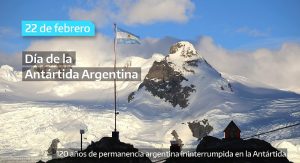
 The other bases are administered by the Joint Antarctic Command (Ministry of Defense). These are Orcadas Base (
 Not to forget that, 22 years ago, WAP (Worldwide Antarctic Program) did launch (on the 3rd week of February) when Febr. 22 falls in it, the
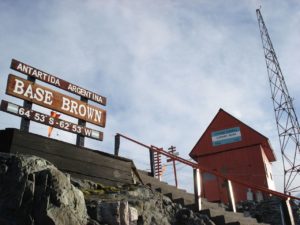 At the beginning of the
  until its partial destruction by a fire in 1984, Base Brown was Argentina’s most prominent scientific station in
  Almirante Brown Station is located in Paradise Bay, on the West coast of the Antarctic Peninsula, one of the most beautiful places in Antarctica, with intense tourist activity in the summers.
 This is an Award dedicated to all the Researchers in Antarctica, and it’s issued with the support of the Ukrainian Radio Clubs: UADXC, DELTA CLUB, RIVNE DX CLUB, UFF (Ukrainian Flora Fauna).
 Well, Laurie Island is the site of the Argentinean Base “Orcadas” (
 Also for the 2025 edition of the
  Since Wednesday, January 15, a fire has continued to ravage part of Amsterdam Island, a district of the French Southern and Antarctic Lands (TAAF). The fire, initially declared near the scientific buildings of Pointe Bénédicte, quickly spread to the vegetation, directly threatening the Martin-de-Viviès Base (
 The fire came dangerously close to the Base during the day on January 16. Although the buildings have been spared at this stage, the surrounding vegetation is severely affected. Several critical infrastructures were damaged, including pipes, the fire main and the power supply to the water treatment systems. This fire also threatens major scientific facilities. Located on Pointe Bénédicte, the Research Station monitors background air pollution, greenhouse gases and aerosols, which are crucial for the IPCC’s work.
 Prof. Lyubomir Ivanov (pic aside) of the Bulgarian Academy of Sciences (born 7 October 1952 in Sofia) is a Bulgarian scientist, and Antarctic explorer. He is a graduate of the St. Kliment Ohridski University of Sofia with M.S. degree in mathematics in 1977. He earned his PhD from Sofia University in 1980, under the direction of Dimiter Skordev with a dissertation titled Iterative Operative Spaces, and was the 1987 winner of Acad. Nikola Obreshkov Prize, the highest Bulgarian award in mathematics. Initiator and participant in Bulgarian mapping and place naming (some 400 Bulgarian names) in Antarctica.
 Ivanov has taken part in several Antarctic expeditions. In 2004, Ivanov went with Doychin Vasilev on the Tangra 2004 topographic expedition, noted by Discovery Channel, the Natural History Museum, the Royal Collection and the British Antarctic Survey as a timeline event in Antarctic exploration.[12][13][14] Awarded the jubilee medal 30th Bulgarian Antarctic Expedition by the Bulgarian Antarctic Institute for his active participation in the expeditions and in the building of St. Kliment Ohridski Polar Base.
 WAP
WAP


 François Bergez, F8DVD will be active as TM22AAW (
 Danilo has got chances to operate Mobile, signing IAØ/IZ1KHY/Mobile while doing tech measurement on the path from LDC to Concordia.
 At the beginning of the season, we did trace the path with GPS, following six known points, which we marked with six numbered poles, stuck on the ice. Now the road is always visible, even in a blizzard, if snowy you don’t get lost at all. The problem is the whiteout when visibility is reduced to almost zero. The whiteout is a meteorological condition in which the contours and points of reference in a snow-covered area become almost indistinguishable.
  During a whiteout it took 5 hours to do the traverse because we must travel between 7 and 10 km per hour. In any case, particularly at this latitude, safety is mandatory so, we have a tracker to be followed by the Concordia operations room during the journey and we have a satellite equipment on board for emergencies, then VHF radio for normality».
 Thanks to Oleg Sakharov (UA1O, R1ANF, ZS7ANF)
  South Pole. Actually Dixie is a Camp for turists who visit South Pole and a refueling station for aircrafts. It has been designed to give the guests the opportunity to experience just what life was like for the original polar explorers, almost a Century ago.
 is so remote, that their nearest neighbor is the International Space Station (ISS) orbiting over 400km overhead!
 The Research Station Johann Gregor Mendel has been built between 2004 and 2006 at 63°48’16” South, 57°53’08” West on the remote James Ross Island in Antarctica, by the Masaryk University in the years 2005–2006, to serve as a base for the Antarctic research of the Faculty of Science, as well as other national and international academic institutions. The plans for setting up a Czech base in the Antarctic go back to the 1990s, when the necessary legal, logistical and later constructional preparations began. The station was completed on 4 March 2006 and it was commissioned during the following research season on 22 February 2007. It was given the name Mendel Polar Station after Johann Gregor Mendel, whose 200th anniversary of birth is commemorated worldwide this year.
 On Jan 2025, a total of twenty-two members, seven women and fifteen men, are participating in the actual Masaryk University expedition to Antarctica. The bulk of the expedition, consisting of fourteen people, did set off on New Year’s Eve. This main group will depart from Vienna Airport for Argentina, from where they will be transferred by a special vehicle of the Argentine Air Force via Marambio Base (
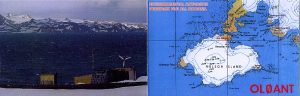 While CZ-Eco Nelson Base (
 s a brand “New One”, never activated on HF by Radioamateurs so far.
 The 24th edition of
 To our friends all over the world, Hams, supporters and followers, to the personnel engaged in various scientific missions in remote Bases and Camps, to the
 Danilo has moved the mast and antenna away from the two big generators that serve LDC Camp, but he had to stop; temp is -46°C he’s afraid that coax cable or dipole wires could break. In any case, changing the position and built a new dipole for 20 mts, appears to work OK now; SWR 1,2 at 14250 and 100 W output, even if the background noise still over S5 to S7. RTX has only 100 W but seems to be enough. Danilo was 44 here again when we tested conditions. He sent an audio recording and 1HYW was 55 with him, fully comprehensible (Audio recording below).
 We should try again in the next few days testing up and down maybe also the Long Path in early morning GMT, to see what time is better. Same fading has been experienced as well by Oleg ZS7ANF on dec. 18th on his second try from Echo Camp; band was completely faded.
 Oleg Sakharov ZS1ANF, UA1O (ex UA1PBA), has been shortly active at
 Today we are going to know something of one of this: Station “C” Sandefjord Bay, (
 Antarctic Base Belgrano II (
 Now, the Refugio Base Belgrano 2, located 7.3 km from the Base and near the snow landing strip, has been named in honor of “Dr. René Favaloro”. This mobile Refuge (77° 52’ 30” South, 34°37’45” West)will provide support in future operations under extreme conditions.
 Named after Doctor René Favaloro, this state of the art shelter, located on a Nunatak, will not only operate as a logistical support point, but will also provide a safe and well-stocked shelter for up to 4 explorers. The installation of the Refuge involves a great effort on part of the base’s staff, the military personnel combine determination and dedication to carry out this mission, reflecting a deep sense of commitment to the Homeland and the desire to lead the way for future scientific expeditions in the region.
 Son of Italian immigrants, René grew up with his grandparents at home, learning Italian, Italian cuisine, Italian music, but above all learning the great manual skills that would accompany him in his medical career, thanks to his father, a carpenter, and his mother, a seamstress: “A good doctor must be a good carpenter.” his grandfather Girolamo would repeat to him. René studied and graduated with honors from the Colegio Nacional Universidad de La Plata. In 1962, one of his elderly university professors encouraged his transfer to the United States, to the Cleveland Clinic, still today one of the most renowned in the world for cardiac surgery. During his intense activity as a specialist, he continued his studies and refined the technique that would lead him to be, in 1967, the first heart surgeon in history to implant the coronary artery bypass, for which – among hundreds of other honors – he would receive a nomination for the Nobel Prize. In 1970, giving up offers of up to 2 million dollars a year to stay in the United States, he returned to Buenos Aires to realize his greatest dream: to create the Favaloro Foundation, a self-sufficient university clinic available to the people, still today the most renowned in South America.
 Lt. Danilo Collino, IZ1KHY (pic aside) is the actual ENEA, Camp Leader at Little Dome C
  Twelve Research Centers are partners in the project, from ten European and non-European countries. For Italy, in addition to the CNR and Ca’ Foscari University, the National Agency for New Technologies, Energy and Sustainable Economic Development (ENEA), is working together with the French Polar Institute (IPEV) on the work module relating to logistics.
 Little Dome C-Epica Camp, WAP MNB-15 is one of the most wanted active site in Antarctica and Danilo IZ1KHY is trying to set up an HF gear to be on air from there and giving the chasers this “New One” activated only once by David FT4YM/P in the year 2022.
 Now a days, modern tourist proposals, allow to visit and stay in some of the most exclusive places in the world, including Antarctica. Inspired by the seminal age of Space exploration,
  As with all
  he new Vostok as seen at the end of the 2023-24 austral summer. The sign НОВАТЭК on the front of one of the modules is for the Russian contractor Novatek which has been constructing the station.
 The new building at Vostok Station (
 In addition to 25 builders, 5 specialists from the Federal State Budgetary Institution
  The first hike, which set off a week ago from the coast of Antarctica to the center of the icy continent, reached the Vostok station.
 HI Folks,
 LT Danilo Collino IZ1KHY/IAØ should be shotly active (SSB) from Little Dome C- Beyond Epica camp (
 SWAIS2C, acronym for “
 West Antarctica is largely covered by the Antarctic ice sheet, but there have been signs that climate change is having some effect and that this ice sheet may have started to shrink slightly. Over the past 50 years, the west coast of the Antarctic Peninsula has been – and still is – one of the most rapidly warming parts of the planet. and the coasts of the Peninsula are the only parts of West Antarctica that become (in summer) ice-free.
  SWAIS2C drill sites are:
  Crary Ice Rise Site 1 or
  What do the researchers study in the most remote scientific corner of Ukraine, at the Antarctic Station “Academic Vernadsky”
  first made VP8ADE out of (in 1978 approximately). It has a new keyer based on a PIC to replace the original G8AGN diode matrix keyer which broke down.
 Parts of icy Antarctica are turning green with plant life at an alarming rate as the region is gripped by extreme heat events, according to new research, sparking concerns about the changing landscape on this vast continent.
 They found plant life — mostly mosses — had increased in this harsh environment more than 10-fold over the past four decades, according to the study by scientists at the universities of Exeter and Hertfordshire in England, and the British Antarctic Survey, published Friday in the journal Nature Geoscience.
 The airfields of the Russian Stations Novolazarevskaya (WAP RUS-Ø9 &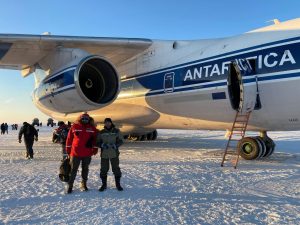
 Russian specialists will provide conditions for safe landing on ice and snow runways for about 20 flights of the IL-76 aircraft giant, whose take-off weight exceeds 200 tons. The Zenit airfield at Progress station is the only site in the world that allows heavy aircraft on wheeled landing gear to be taken to the snow strip. Six flights are expected there this season, with scientists from Russia, China and India arriving. The first flight to Progress Base has already delivered a team of Russian builders and materials for equipping a new wintering complex at the Vostok intercontinental station. The sledge-crawler trek will go deep into the continent in just a few days” said Alexander Makarov, director of the Arctic and Antarctic Research Institute
 On the mean time, Oleg Sakharov ZS1ANF who is at Cape Town at the moment, has just called to inform that he is preparing for the next season in Antarctica, where he will be at Wolf’s Fang Runway (
 Lt. Danilo Collino (pic to the Left) has departed this morning at 03:00UTC from Milan-Airport heading Antarctica, Danilo will sign IZ1KHY/IAØ from few different locations; Concordia (
 Brabant Island, 64°27’ South, 62°14’ West is nearly 561m long and 24km wide and is the second largest island in the Palmer Archipelago. At one time it was one of the largest still to be explored in the world. It lies 400km south of the Antarctic convergence and east of Grahamland, sitting in a rather weather-beaten zone where winds are regularly above force 12.
 Most of the members of the expeditions weren’t university-level scientists but rather experienced mountaineers. This gap was however filled by the support of numerous research institutions including, among many others, the Belgian Antarctic Committee. An impressive total of 60 scientific projects were carried out, covering topics ranging from natural sciences to sociology and human physiology. “This diversity of aim is, we believe, only possible in a Service expedition such as this free from the constraints of publication, academic rivalry and the need for immediate results.
 Base Camp was right in the middle of a colony and the smell took some getting used to. The expeditionners set about unpacking and organising their 15 tonnes of kit. Farewells were brief and the 12 man team had started its big adventure. The first few weeks flew by as we erected a small tri-wall hut for use as a laboratory and a meeting place, and carefully worked out the stores and food area. This had to be marked and carefully recorded for soon it would be buried in snow. With a ready stock of most small things in the hut annex, the stores system worked very well, and only occasionally they have to dig in to find a some of the items